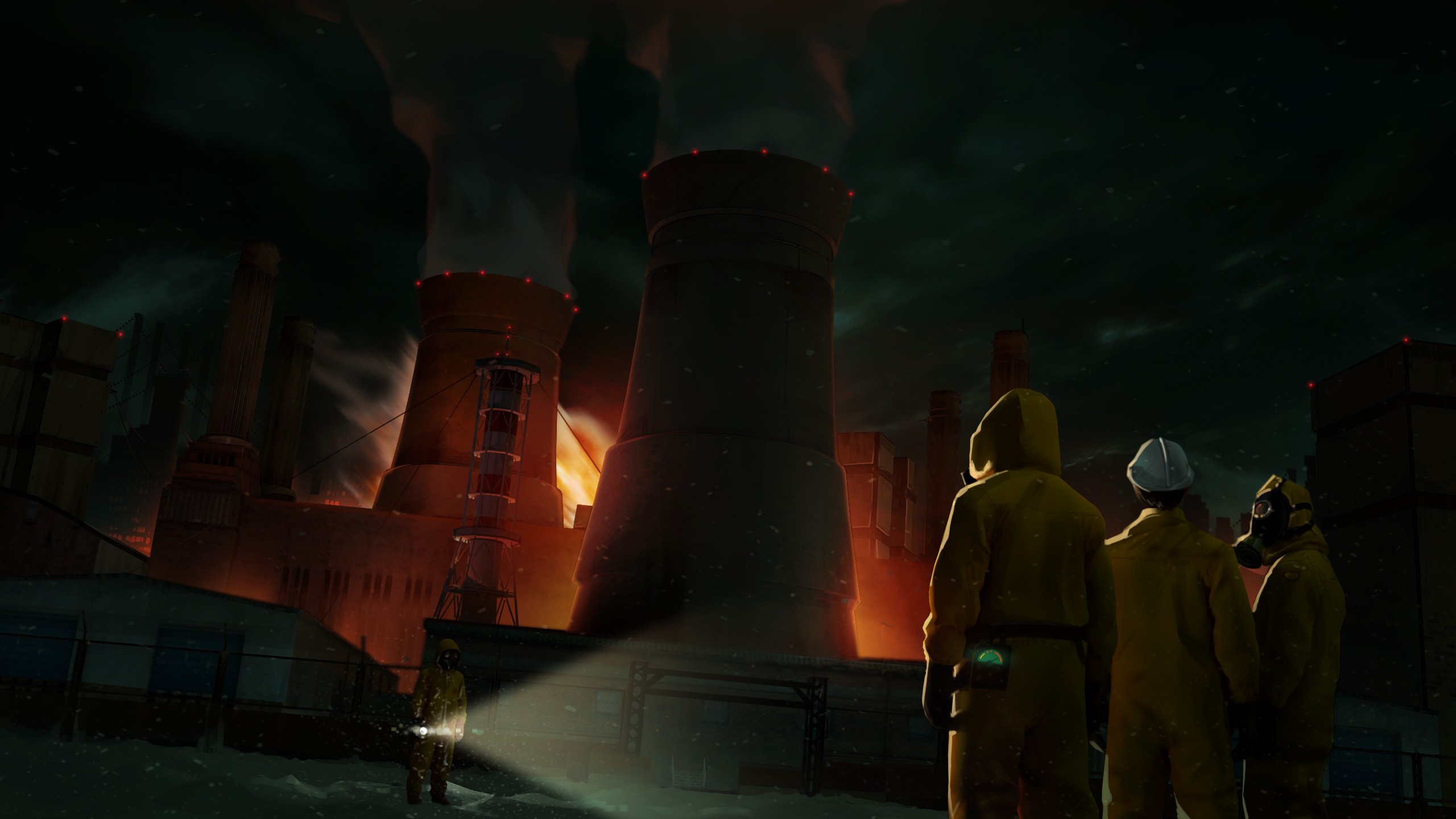

Help shape the tense, cooperative core of a 4-player first-person game about surviving a nuclear reactor as systems fail and pressure escalates. You’ll build on early prototypes to refine teamwork-driven objectives, readable interactions, dynamic events, and a grounded, horror-leaning atmosphere powered by lighting and sound. The focus: clear roles, strong communication, and replayable runs where the environment—not monsters—is the threat.
What you'll learn
Learn production-ready fundamentals in office hours led by real-world experts. Build the skills to be job-ready on a professional team and ship your indie project with confidence. On top of that—and what makes RealXP Lab different—you’ll learn by shipping inside a real commercial project and production pipeline. You'll level up through PR code review, feedback emails, performance reviews, and the organic learning that happens on real teams (conversations, self-directed exploration, and studying the codebase).
Production-focused curriculum
Learn a rigorous curriculum built for junior engineers and grounded in real production needs, covering everything from production workflow and code quality to optimization and Unity architecture.
Multiplayer Networking
Ship reliable 4-player co-op with synchronized interactions, shared objectives, role-based teamwork, and clear client-side feedback.
Procedural Generation
Build replayable runs using procedural variation and dynamic events that ramp tension and difficulty without feeling random or unfair.
State Machines & Gameplay Systems
Implement state-driven reactor systems: operations, failures, repairs, and progression, supported by lighting and sound that maintain a grounded, horror-leaning tone.
What you'll deliver
Working alongside a Senior Unity Engineer lead, your project deliverables include:
A playable core game loop with early “game feel,” focused on mechanics and iteration rather than visual polish.
Working 4-player co-op multiplayer with a repeatable local testing setup (server/host + multiple clients) and the primary game loop running end-to-end in a shared session.
Nice-to-haves: procedural generation to increase replayability, plus automated tests and lightweight testing infrastructure.
About Voids Within
Voids Within is an independent studio led by developer Matt Marshall, focused on atmospheric, mood-driven games. Its standout release, Dystopika, is a “dark cozy” cyberpunk city-building sandbox that prioritizes creativity and ambience over goals or management.
Dystopika
A city-building sandbox for futuristic cities. No goals, no management, just creativity and dark cozy vibes.
Overwhelmingly Positive
(2,270)
Meet your leads

Matt Marshall
CEO @ Voids Within | Game Director | Designer | Lecturer
Matt is a Toronto-based designer, developer, and creative director working at the intersection of games, VR, and interactive media. He runs his own indie label, Voids Within. With a background spanning theatre, visual effects, UX/design leadership, and hands-on development, Matt blends strong art direction with a builder’s mindset, crafting atmospheric experiences and creative tools that invite players to explore, experiment, and make their own worlds.
Earlier, Matt directed and built titles like The Veil and led award-winning concept work, including imagined Martian habitat devices that earned the Grand Prize in Microsoft’s Hacking Mars challenge (2015). He’s also taught XR Prototyping at Ryerson University (now Toronto Metropolitan University) and led teams as Head of Design at Circuit Stream.
In 2022, he left his job, sold his belongings, and set off across Asia to pursue his indie journey while exploring new cultures and perspectives. He works and travels with a single 35L backpack. Along the way, he’s tried some truly adventurous foods, including snails, scorpions, and even a live, beating cobra heart.

Walter Gordy
Unity Technical Lead | Senior Engineer | Systems Architect
Walter is a senior engineer who builds the foundations teams depend on, moving quickly without sacrificing stability at real-world scale. Based in Edmonton, he brings 15+ years of experience spanning game development and embedded systems, with deep hands-on work across Unity/C#, Python, C/C++, FPGA/VHDL, optics, MEMS, and high-speed data acquisition.
In games, Walter has led and supported Unity teams on shipped, live-operated titles with millions of installs, building gameplay systems, editor tools, content pipelines, and CI/CD that improved stability and delivery speed. His work includes a Netflix-supported title delivered in 30+ languages, and as Technical Lead at Part Time Games he drives rapid prototyping and core architecture for cozy couch co-op experiences. He also consults on architecture, feature design, and technical direction, helping teams solve tough boundary issues across code, data, hardware, and real players.
Outside of software, Walter teaches ceramics, builds in the wood shop, and bikes Edmonton year-round—even when it’s -40 degrees.
Who is this for
Students and new grads who want to build strong professional habits early and turn solid skills into credible, job-ready experience.
Hobbyists and career switchers who want to break into the industry with proof beyond solo projects, or ship indie titles with confidence.
Professional game devs who want to sharpen resume signals, push their skill envelope, and raise their ceiling with direct, high-signal critique.
Prerequisites
Unity & C# basics
You should already be comfortable working in Unity and C#, have participated in a few game jams, and have shipped at least one small project on itch.io or Steam.
Bring an open mindset
The real gap between a hobbyist and a pro isn’t just technical skill—it’s initiative taking, jumping into an existing codebase, and being willing to throw away work that doesn’t serve the game. Come ready to be challenged and to push yourself.
What's included
Live sessions
Learn directly from real-world experts through live, interactive sessions.
Guest lectures
3 guest talks by industry veterans, each focused on their area of expertise.
Lifetime access
Rewatch recordings anytime and keep access to our internal resource library.
Career support
Get mock interviews plus portfolio and resume reviews focused on industry readiness.
Industry network
Join a lasting network of like-minded peers, mentors, and industry professionals.
Supplementary curriculum
24 mentor office hours • 12 learning topics
Week 1
Code Review & PR Ritual
Mentor Office Hour
Establish production-grade review loop that keeps teams shipping: scoping changes, actionable feedback, quality gates, and consistent merge cadence.
Git CLI Basics
Mentor Office Hour
Build clean day-to-day Git habits, including branching strategy, commit hygiene, and when to rebase versus merge.
Writing Readable, Maintainable Code
Weekly Learning Topic
Learn to follow a shared style guide to write clear, maintainable code with strong naming, structure, and minimal duplication.
Week 2
Debugger Walkthrough
Mentor Office Hour
Discover the debugger as a daily tool and understand the basics of breakpoints, stepping, inspecting state, and tracing bugs to the root cause.
Resolving Merge Conflicts
Mentor Office Hour
Resolve conflicts safely by understanding intent on both sides, choosing the right edits, and validating the result before merging.
Unity Null Safety
Weekly Learning Topic
Build Unity null safety awareness: handle Unity’s special null behavior and add lightweight guards around references.
Schedule
Team Sync is the only required session; everything else is optional. Times will be set based on cohort availability, and the schedule may be adjusted as needed.
MON
Standup
5 min
Team Sync (Required)
1 hour
TUE
Mentor Office Hour
1 hour
WED
Standup
5 min
Project Tag Up
1 hour
THU
Mentor Office Hour
1 hour
FRI
Standup
5 min
Studio Office Hour
1 hour
Testimonials
"This program has given me more game development knowledge than three years of studying game programming, and I'm really glad to have the chance to work with so many great people."

Mateusz Stanek
Game Programmer
"The instructors were all very knowledgeable, experienced. In addition to learning coding skills, we also learned a lot of "on the job" skills like agile workflows, code reviews, and how to work with a team of other programmers. Overall, I think it was a great experience that will help me land a great game dev job."

Ryan Maidhof
Mechanical Design Engineer, ASML
"Compared to my last internship, this absolutely blows it out of the water. This is a very engaging program, and I appreciate that it feels more like actual work rather than someone holding my hand through every step."

Ryan Smith
Software Engineer, Smith Parker Elliott
"RealXP Lab was one of the most valuable learning experiences I've had so far as a game developer. The pacing and environment felt much closer to a real studio than anything I've experienced in college, and I came out of it feeling confident that I can hit the ground running in a professional role. I also met amazing people and built connections that I know will be extremely valuable."

Zach Petty
B.S. in Game Programming and Development, SNHU
"Students are trusted with meaningful ownership and given the freedom to explore. Effort is rewarded: the more dedication invested, the richer the experience becomes through deeper mentorship, greater responsibility, and accelerated growth. It’s a strong bridge between personal projects and real-world production workflows."

Murat Diken
Unity Developer, Æ Labs
"As a self-taught game developer, I lacked both a network and confidence in my skills—RealXP Lab provided me with both. The program not only connected me with like-minded peers and invaluable mentors, but also gave me hands-on experience in a professional environment and the reassurance of feedback from industry experts."

Zack Coleman
Freelance Game Developer
Frequently asked questions
Share