Blog
Game Design
What Cairn Teaches Us About Presence, Story, and Difficulty
Monthly series from RealXP Lab Game Design Club
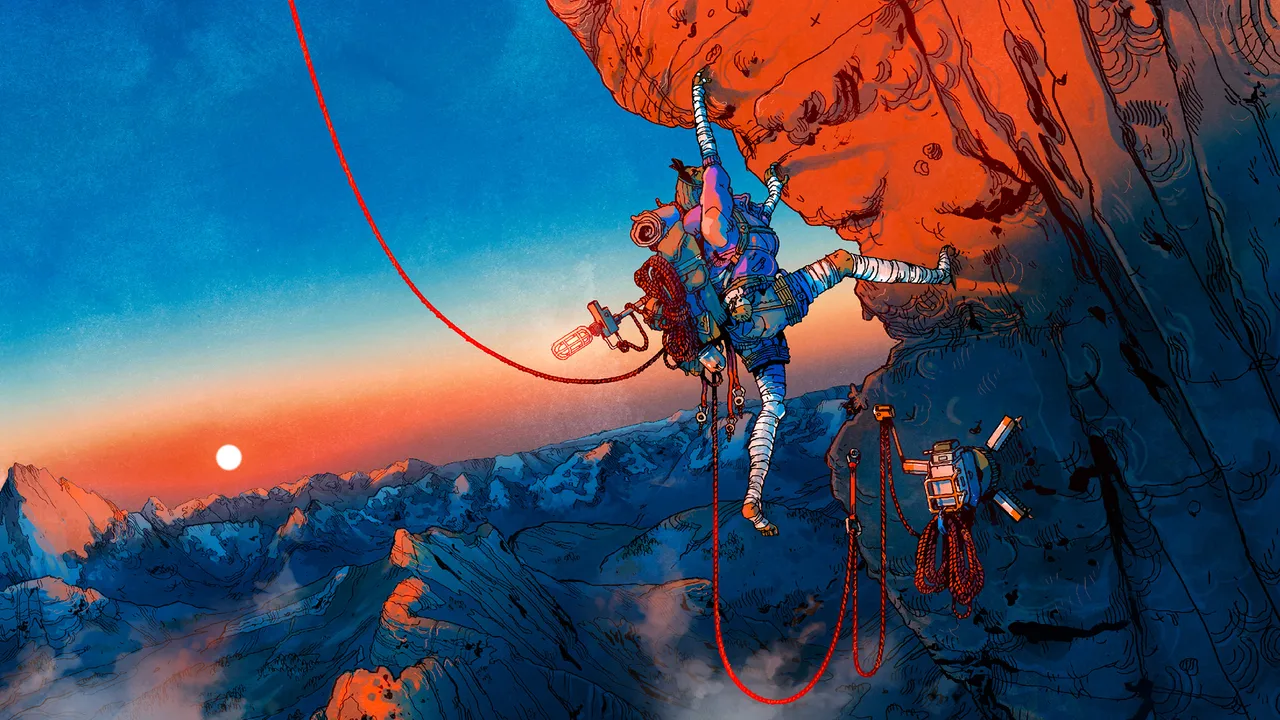
One of us picked Cairn up and started on Free Solo, the hardest difficulty, as a first playthrough. Ten hours in, still not halfway up the mountain. After a near-fall where both of the character's legs swung off the wall, they had to set the controller down for ten minutes to recover. "I was physically tired after that climb." Another of us played it twice, once on each difficulty, and came back describing two completely different games. Same mountain, same mechanics, different sport entirely. We spent a session pulling that gap apart.
The Game
Cairn is a "survival climber" by The Game Bakers (creators of Furi and Haven), released January 29, 2026 for PC and PS5. You play Aava, a pro mountaineer attempting the first ascent of fictional Mount Kami, and the core mechanic is unusual: you manually control each of her four limbs, placing hands and feet on the wall one at a time. Around that core sit survival systems (hunger, thirst, temperature), a physics-based backpack inventory, weather and day-night cycles, and difficulty modes ranging from forgiving Alpinist (~12–15 hours) to brutal Free Solo (25–30 hours with no checkpoint reloads). Steam reviews sit at "Very Positive" with 94% of 8,400+ users approving.
Why You Can't Zone Out When You Have Four Limbs to Move
What Cairn does: Climbing happens limb by limb. You press a button to grab the next hold with a hand or foot, and the game releases whichever limb is bearing the least weight to free it for the next move. You're reading the rock and planning the next two moves before you commit. There's no "hold a button to climb" shortcut.
Why it's interesting: Both of us hit the same flow state, fast. The kind where two hours vanish and you forget you were supposed to be analyzing the game. One of us noted that with a single-button climb mechanic, you can disable your brain a little. Cairn won't let you. Every move requires you to look at the wall and decide. The result is rare: sweaty palms, tense shoulders, a need to step away after a hard pitch. What sells it is the restraint: one limb at a time, instead of mapping each to an analog stick the way older climbing games did.
Our take: We started calling this forced presence, designing mechanics that physically prevent a player from running on autopilot. Most "engaging" mechanics are engaging because they're fun. Forced presence is engaging because disengaging costs you. Where in your own game can a skilled player coast on muscle memory, and is that always a feature?
When the Story Is the Climb, Not the Cutscene
What Cairn does: Cairn has a written, linear narrative with cutscenes, voice acting, environmental storytelling, and a clear emotional arc for Aava. But it's a mostly solitary game, and the bulk of your time is spent on the wall.
Why it's interesting: The strongest story moments in our playthroughs didn't come from cutscenes. They came from surviving a climb that nearly killed us, then walking into a camp where Aava radios her partner and the music swells. The cutscene wasn't doing the emotional work on its own; the climb did the work, and the cutscene caught the fall. One of us drew the comparison to World of Warcraft: you don't remember the quest text, you remember the random stranger who helped you in a dungeon. Your brain attaches whatever emotion the gameplay produced to the story unfolding around it, and suddenly the narrative is doing more lifting than the writing alone deserves credit for. The flip side: a cutscene that triggers mid-climb, with the camera ripping you out of the wall and snapping your character to a fixed position, breaks the spell instantly. It happens once with a young climber you meet, and once is enough to make you flinch every time the camera shifts after that.
Our take: We named this gameplay-primed emotion. The player arrives at a story beat already feeling something the game put there. Pre-rendered drama then lands harder than it deserves. Most games invert this, asking cutscenes to do the emotional lifting cold, with no setup from the loop itself. It made us wonder what writing for a game would look like if the brief was "the player will arrive at this scene already exhausted and relieved, write to that." It also made us suspicious of any cutscene that interrupts a flow state instead of resolving one.
Same Mountain, Two Games
What Cairn does: The difficulty modes aren't just numeric tuning. Alpinist is the standard mode with frequent autosaves, generous resources, a larger backpack, and resurrection flowers placed reasonably. Free Solo cuts the backpack to a third of its size, makes every recipe ingredient feel precious, and removes the rope and saves to give falls a much more permanent consequence.
Why it's interesting: One of us did both and described them as two completely different games. Alpinist is a flow-state climbing simulator with beautiful vistas and time to read the landscape. Free Solo feels more like a survival horror game where you find yourself locked in on every movement and decision. The design holds up under both readings. The rope is the biggest driving factor. In Alpinist it's not just a safety tool, it's a movement tool that opens up swinging and sections of the mountain that deliberate climbing alone can't reach, and encourages exploration because you can always pull yourself back to where you were. Remove it in Free Solo and you're not just playing a harder version of the same game, you're playing one with a different movement vocabulary where every detour risks all your progress.
Our take: It felt less like a game with difficulty settings and more like a game designed at two skill levels in parallel, with mechanics that play different roles in each. We started thinking of this as mode-as-genre. It's an unusual amount of design effort, and it's worth asking on any project with difficulty modes: are your harder modes just the same game with bigger numbers, or could they be a meaningfully different experience?
The Verdict: Must Study
The longer we talked about Cairn, the more design lessons we pulled out of mechanics that, on the surface, just look like a good climbing simulator. The limb-by-limb control isn't a gimmick, it's a forced-presence engine. The cutscenes don't carry the story, the climbs do. The minor gripes (a mid-climb cutscene that teleports you, no achievement for finishing Free Solo, occasional climbing-down jankiness, an inventory minigame that gets old) only surface when you go looking for them. The concepts the discussion produced (forced presence, gameplay-primed emotion, mode-as-genre) came out of trying to articulate why Cairn worked on us as hard as it did, and they travel.
We rate games on how much they teach you about game design, not how much fun they are on a Friday night.
Must Study — packed with design lessons every game dev should see firsthand
Worth Studying — meaningful takeaways that reward close attention
Skim It — a few interesting ideas, but you can learn them secondhand
Pass — not much to learn here

RealXP Lab
Share